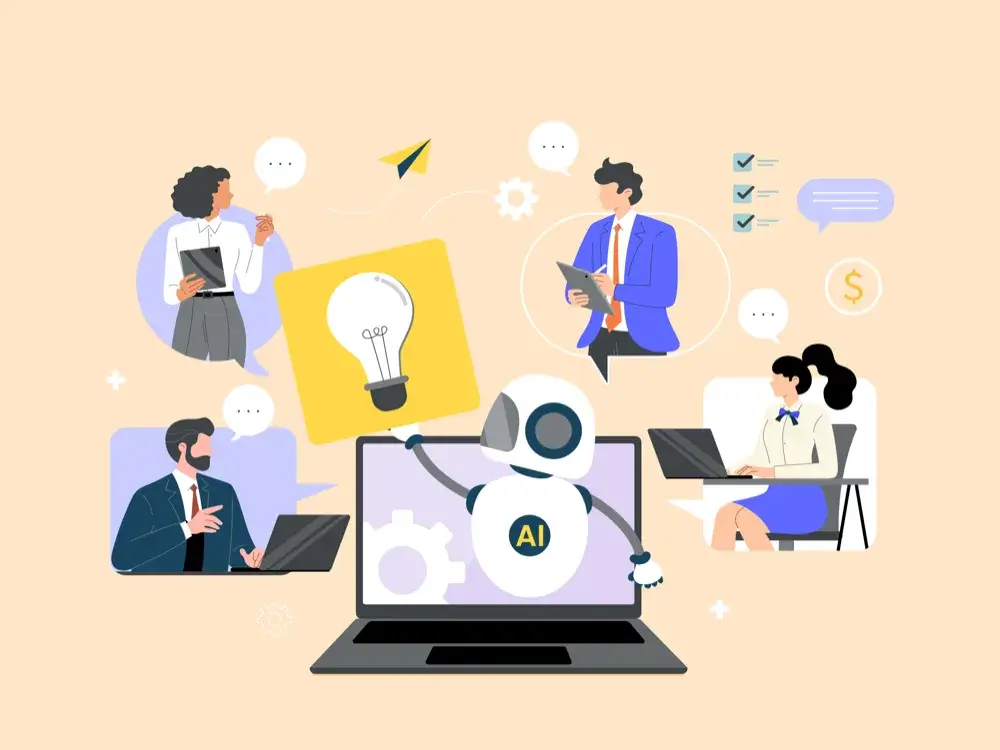
AI training as a competitive advantage
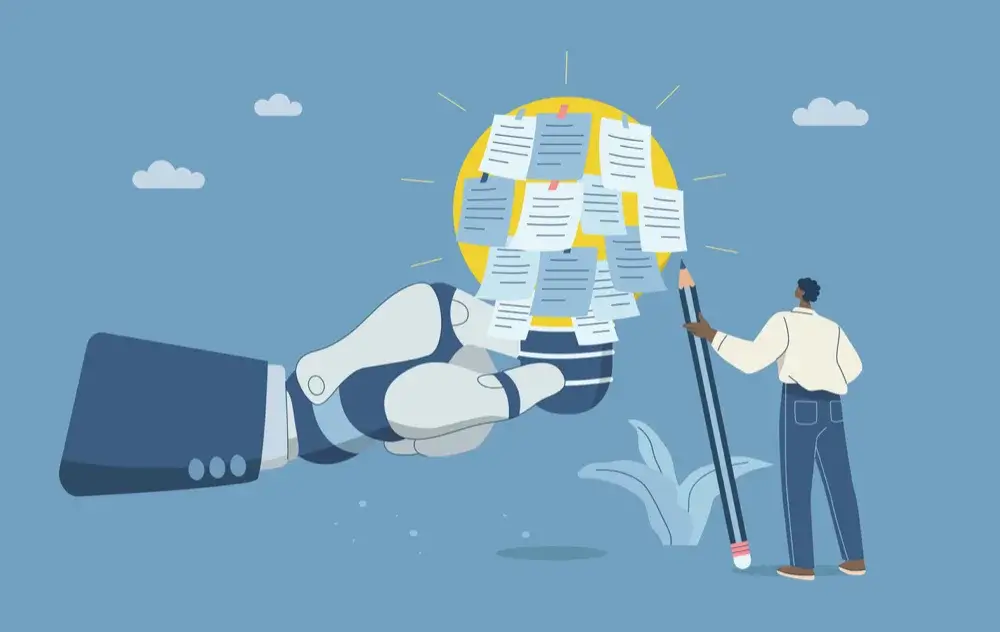
Why companies need to invest in structured AI skills now
Artificial intelligence offers companies the opportunity to make processes more efficient and to further develop existing systems in a targeted manner. It is therefore all the more important to exploit their full potential. But this is exactly where many companies face a major challenge: It often remains unclear how to not only use AI but also use it strategically. This article shows why investing in building AI expertise is now crucial and why structured, modular learning journeys are the key to sustainable action.
Between the Pressure to Innovate and the Skills Gap
Artificial intelligence is no longer unknown. Even though its concrete effects in the coming years are not yet fully foreseeable, we know that it can fundamentally change business models and decision-making processes every day. The resulting competition puts companies under pressure. This pressure not only forces them to rethink and adapt their processes, but also to train their employees to be able to use and constantly develop these new technologies.
Especially when companies consciously choose to use artificial intelligence, as a consulting company, we see a gap between future professional requirements and the current level of expertise. This gap threatens companies and requires quick action, as it leads to uncertainty, overwhelming demands and a lack of ability to act while the competition is already in the fast lane.
Upskilling instead of job cuts
In practice, it has been shown that the importance of vocational qualification and continuing education of employees in the context of new technologies is not yet sufficiently prioritized in many companies. While investments are being made in new systems and tools, the targeted development of the competencies required to use them is often lagging behind. According to the IBM Institute for Business Value Results However, 40% of employees must be re-qualified by 2027, as artificial intelligence has fundamentally changed or will continue to change their work processes and job profiles.
This change is causing many employees to be uncertain about their professional future. But education is essential when it comes to this topic in particular, because artificial intelligence does not necessarily lead to job losses, but can also create new ones. But in order to be able to fill these new jobs, both the adaptation of companies to the new circumstances and the AI skills of employees are of great importance.
AI competence is mandatory: The EU AI Act
AI has arrived in our everyday working lives. It is up to companies themselves how to use the new potential. Because the decision as to whether companies want to train their employees at all is no longer up to them. The EU AI Act obliges companies to train their employees from February 2025 and introduces a requirement to prove sufficient AI competencies (Art. 4 KI VO). However, these requirements are largely vague in their practical implementation and have so far left room for interpretation with regard to the specific design of training measures.
The EU AI Act obliges companies to train their employees from February 2025 and introduces a requirement to prove sufficient AI competencies (Art. 4 AI Regulation).”
AI competence can be described as knowledge and understanding of how to use AI and also includes knowledge of opportunities, risks and the resulting potential damage. In addition to technical skills, legal and ethical knowledge is also important in order to be able to make well-founded decisions in working life.
AI competencies promote innovation and competitiveness in companies as they increase employee efficiency and productivity. Artificial intelligence, for example, helps automate recurring daily tasks so that you can use the resulting free time for more strategic work.
In addition, conscious use of artificial intelligence minimizes potential security risks that can arise due to a lack of knowledge, such as when sensitive company information is carelessly entered into tools or systems. Therefore, AI expertise means more than just using tools. It is about the meaningful use of AI, a new mindset and the ability to identify and further develop AI potential.
Twelve areas of expertise for the future
The complexity of AI competence can be explained in more detail using the so-called AICOMP model. According to the AICOMP model, AI competencies can therefore be divided into twelve fields of competence, which are reflected in the three dimensions of Work & Task, Personal Development and Organization & Social Environment. Your own competence profile therefore consists of the following competencies:
1. Activity and Implementation Expertise
2. System design expertise
3. Creative problem-solving skills
4. Critical digital literacy
5. Decision-making competence
6. Self-effectiveness
7. Critical thinking
8. Active Control
9. Self-determination
10. Ethical competence
11. Cooperation expertise
12. communication skills
From individual training to learning architecture
Anyone who wants to fully exploit the potential of AI competencies in their own company and use AI strategically must understand that AI competence is multi-dimensional. Systematic learning architectures are essential in order to be able to develop such a competence profile. AI Competence is not only created through a single training session, but also through structured, sequential learning modules that take into account various competency dimensions.
However, this skill development is not automatic. Although employees can acquire knowledge about artificial intelligence themselves, without strategic anchoring, progress often remains fragmented. Companies are therefore faced with the responsibility of managing qualification in a targeted manner and creating the necessary framework conditions. Although individual training can provide a quick start, it is not sufficient for long-term and sustainable development of competencies.
“AI competence is not only created through a single training session, but through structured, sequential learning modules that take into account various competency dimensions.”
An established training culture in the AI sector does not yet exist in many companies. Our practice shows that the development of AI competencies often only takes place on a situational or project-related basis and is less systematically anchored. It is therefore all the more important not to leave the continuing education of employees to individual initiative, but to see it as a strategic task of the company.
Modular AI learning trips for growing AI expertise
Sustainable learning concepts are needed to systematically build up AI competencies. One approach to this is modularization. Modularization essentially means breaking down a whole into several individual parts. In the area of qualification, modules can be described as self-contained learning units that have their own, clearly defined learning objective. Individual modules are combined to form structured learning trips.
“In order to be able to optimally structure a learning journey, a needs analysis is required at the beginning.”
These learning trips promote employee development through a mix of basic training, workshops and specialized training offers for various employment groups. In addition to a general basic understanding, this also makes it possible to cover possible applications in one's own working life. In order to be able to optimally structure a learning journey, a needs analysis is required at the beginning. This analysis should show which AI systems exist in the company, who uses them and what competencies are available in this group. This promotes the development of targeted training units.
Building sustainable AI expertise is complex, as it develops dynamically, depends on one's own professional role and is also relevant from a regulatory perspective. In order to be able to sustainably manage and further develop this complexity, isolated training courses are less suitable. Because sustainable competency development requires structured and modular learning architectures.
.webp)